How Long Do Pool Screens Last in Florida? A Complete Owner’s Guide
If you own a pool home in Florida, your screen enclosure (or “lanai enclosure”) works 24/7/365 under some of the most punishing weather conditions in the country. Florida’s intense ultraviolet radiation, high humidity, torrential summer downpours, severe tropical storms, and coastal salt air constantly attack every component of your structure. So, how long can you truly expect your pool screen enclosure to last before needing major repairs or a full rescreen?
On average, a standard pool screen mesh in Florida lasts 7 to 15 years, while the underlying structural aluminum frame can easily last 20 to 30+ years when properly engineered and maintained. However, the gap between an enclosure that fails after 5 years and one that stays taut for 15+ years comes down to material engineering, fastener selection, wind load compliance, and maintenance protocols.
At Florida Precision Screens, we help homeowners navigate material selection, frame structural integrity, and local building code compliance. This comprehensive guide breaks down everything you need to know to maximize your investment.
Anomaly Breakdown: Frame vs. Mesh vs. Fasteners
A pool screen enclosure is not a single uniform structure; it is an assembly of three distinct materials that age and degrade at drastically different rates.
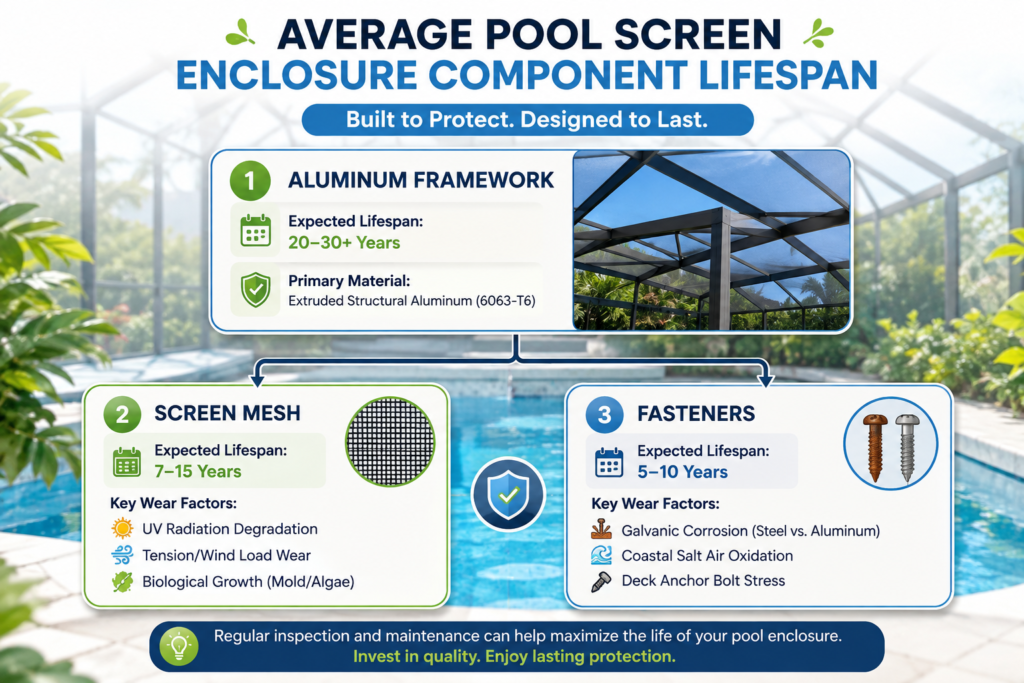
1. The Aluminum Frame (20 to 30+ Years)
Constructed from heavy-gauge extruded aluminum (typically 6005-T5 or 6063-T6 alloys) with an electrostatically applied powder coat or baked-enamel finish. The structural frame is impervious to rust and rot, making it the longest-lasting asset of your enclosure.
2. The Screen Mesh (7 to 15 Years)
The mesh panels absorb constant wind friction and UV degradation. Over time, UV rays break down the protective vinyl/PVC coating around the inner core fibers, causing the screen to become brittle, fade from deep charcoal black to light gray, and tear under minor wind pressure.
3. Structural Fasteners & Spline (5 to 10 Years) — The Hidden Failure Point
While aluminum frames don’t rust, standard steel screws used to secure the frame to your concrete deck do. Galvanic corrosion occurs when dissimilar metals (steel fasteners and aluminum extrusions) touch in the presence of moisture/salt, rusting out screws long before the frame fails. Additionally, the rubber/vinyl spline holding the screen in the frame channels bakes in the sun, shrinks, and loses grip.
The 5 Major Factors Influencing Enclosure Lifespan in Florida
1. Intense UV Radiation & Solar Heat
Florida experiences some of the highest solar irradiance levels in the US. Ultra-violet (UV) light photo-oxidizes screen coatings. Cheap fiberglass mesh loses elasticity, turns brittle, and tears under light wind loads within 5 to 7 years.
2. Florida Building Code (FBC) & Wind Load Engineering
Following major hurricanes, the Florida Building Code (FBC) updated structural engineering requirements (ASCE 7 standards) for open-structure screening. Enclosures built prior to 2014 were often engineered to lower wind thresholds (110–120 mph).
Modern enclosures engineered for 140–170+ mph ultimate wind speeds utilize heavier aluminum wall thicknesses, reinforced gusset plates, and heavy-duty K-bracing to survive storm surges and pressure shifts.
3. Coastal Salt Air & Micro-Climates
If your property is within 5 miles of the coast (Gulf or Atlantic), airborne sodium chloride drastically accelerates degradation. Salt deposits react with low-grade fasteners and exposed aluminum edges where paint has chipped, causing white oxidation powder and structural weakening.
4. Irrigation System Overspray
Sprinkler water high in iron, hard minerals, or reclaimed water chemicals repeatedly blasting your screen frame leads to severe mineral scaling, paint degradation, and premature fastener corrosion near ground level.
5. Nearby Vegetation & Biological Growth
Trees dropping sap, acorns, and pine needles over your enclosure create organic pockets that trap moisture. In Florida’s humid environment, this rapidly breeds green algae, mold, and lichens that root into the screen weave, rotting fibers prematurely.
Screen Material Breakdown: Performance & Lifespan Matrix
Choosing the right replacement mesh is the single biggest choice affecting how long your pool enclosure remains tear-free.
| Screen Material Type | Typical Lifespan | Primary Composition | Ideal Use Case | Pros & Cons |
| Standard Fiberglass (18×14 Weave) | 7 – 9 Years | Woven glass fibers coated in PVC | Budget-friendly standard installations | Pros: Low upfront cost, clear visibility. Cons: Brittle under high UV, low tear resistance over time. |
| No-See-Um Mesh (20×20 Weave) | 10 – 14 Years | Ultra-tight woven fiberglass | Homes near marsh, water, or coastal zones | Pros: Blocks tiny midges (no-see-ums), gnats, and debris. Cons: Slightly reduced airflow and light transmission. |
| Heavy-Duty Polyester (Poli-Mesh) | 15 – 20+ Years | High-tenacity vinyl-coated polyester | High-wind areas, long-term durability | Pros: Virtually tear-proof, 3x stronger than fiberglass, excellent warranty. Cons: Higher initial material cost. |
| Pet-Resistant Screen | 10 – 15 Years | Heavy-gauge vinyl-coated polyester | Homes with dogs, cats, or wildlife activity | Pros: Resists clawing, scratching, and impact. Cons: Thicker strand diameter reduces outward transparency. |
Warning Signs Your Pool Screen Enclosure Needs Attention
Catching minor structural or mesh failures early prevents full enclosure failure during a major storm event.
Mesh Degradation Signs
- Silvering or Fading: The original dark charcoal color turns light gray or silver, indicating the protective PVC coating has burned off due to solar exposure.
- Spline Rollout: The black rubber cord securing the screen in the frame groove begins hanging out, leaving screen edges loose and flapping in the breeze.
- Tears Along Panel Margins: Tears appearing along the aluminum frame edges indicate the mesh has lost elasticity and is shearing from normal wind movement.
Structural & Frame Degradation Signs
- Chalky White Residue on Aluminum: Indicates aluminum oxidation where the protective paint coat has eroded away under environmental exposure.
- Rust Stains at Base Plates & Connections: Reddish-brown streaks indicate steel fasteners are deteriorating via galvanic corrosion and losing structural hold on your concrete slab deck.
- Structural Frame Rattle: If your enclosure sags, sways, or rattles audibly in mild 20–30 mph winds, K-bracing, purlins, or concrete anchor bolts have compromised tension.
4 Professional Tips to Extend Your Enclosure’s Lifespan
Step 1. Gentle Washing (Twice Annually)
Perform bi-annual low-pressure washing in Florida to eliminate salt and mold. Wash your enclosure using a soft-bristle brush, mild biodegradable soap, and standard garden hose pressure. Never use high-pressure power washers directly on screen panels, high PSI cuts through aging screen strands and strips protective powder coating off aluminum frames.
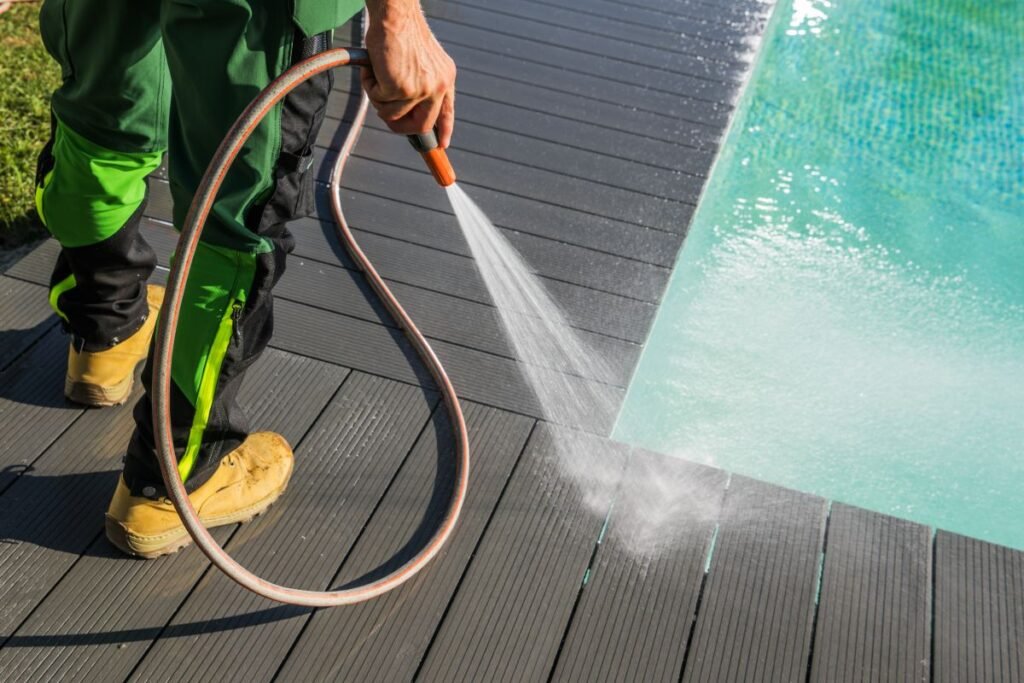
Step 2. Replace Fasteners with Stainless Steel or Nylon-Capped Hardware
Upgrade rusted structural screws to non-corrosive fasteners. Replace old rusting carbon steel frame screws with 316 marine-grade stainless steel or nylon-head fasteners. Upgrading hardware prevents galvanic reaction and ensures your enclosure stays securely anchored to your home foundation during high winds.
Step 3. Maintain Landscape Clearance Around the Perimeter
Keep overhanging trees trimmed at least 6–8 feet clear. Trim back overhanging oaks, palms, and pines. Branch rub tears mesh easily during storms, while falling pine needles and leaves accumulate on flat mansard/dome roofs, trapping moisture and breeding screen-rotting fungi.
Step 4.Conduct Pre-Hurricane Season Hardware Inspections
Perform pre-storm tension and hardware checks. Every May, inspect door closers, latch mechanisms, tie-down cables, and screen spline tension. Ensure screen doors latch completely; unlatched enclosure doors are the #1 cause of wind uplift damage during hurricanes.
Read Next: How to Repair a Pool Screen Enclosure in Florida
Why Florida Homeowners Choose Florida Precision Screens
Building or restoring a pool screen enclosure in Florida requires specialized knowledge of local climate pressures and strict building codes. At Florida Precision Screens, we don’t cut corners.
- FBC Code-Compliant Engineering: Every rescreening, frame restoration, and enclosure installation is engineered to meet or exceed current Florida Building Code wind load parameters.
- Premium Material Standards: We specialize in high-durability polyester meshes and 316 marine-grade stainless steel fasteners designed to withstand coastal conditions.
- Full-Structure Audits: We don’t just patch screens, we evaluate your entire system, including frame structural integrity, beam splices, cable tie-downs, and concrete anchors.
Get an accurate estimate for your screen enclosure repair or installation. Contact us today for a free consultation.
Frequently Asked Questions
How often should pool screens be replaced in Florida?
Most pool screen mesh requires full replacement every 10 to 15 years. If you use standard fiberglass mesh, plan for replacement every 7 to 9 years. Upgrading to heavy-duty polyester mesh can extend lifespan past 15 to 20 years.
Can I replace individual torn panels, or should I rescreen the entire enclosure?
If your enclosure is under 7 years old and damaged by an isolated incident (like a fallen branch), replacing single panels makes economic sense. However, if your screens are over 8–10 years old and showing overall fading or brittleness, replacing single panels often leads to adjacent panels blowing out shortly after. A full rescreen enclosure is significantly more cost-effective per panel.
Does living near the coast reduce enclosure lifespan?
Yes! Properties within 5 miles of saltwater experience faster aluminum paint chalking, rapid fastener corrosion, and accelerated screen fiber wear due to airborne salt crystals and wind-driven sand friction. Coastal enclosures require marine-grade hardware and regular fresh-water washdowns.
What is the strongest pool screen material for hurricane protection?
High-tenacity vinyl-coated polyester screen mesh (such as Super Screen or TuffScreen) is the strongest material on the market. It exhibits up to 300% higher tear strength than standard fiberglass and resists tearing under extreme wind pressure and flying debris impact.